Thursday, October 12, 2017

Burgundians versus Lancastrians

A club league game where my Burgundians sit and wait the Lancastrians.

 Oh dear, on my CinC's first roll he is downgraded.
I guess it is tempting fate too much to start with a general rated as a genius.

 My whole army sitting on opportunity, 
watching the enemy who are likewise sitting on opportunity.

 Fate can be cruel.
On my CinC's next role he gets upgraded, 
except he can't as he's already been downgraded.

 The Lancastrian's start to move their right flank.
I plan to move my left flank knights to my centre and then launch a devastating charge down the gap between the two fields.

 My knights take a while to get moving
Meanwhile I advance my archers.

 Shooting starts and it does not go well.

 This is going to be tricky

 On the right the shooting is also not going well for me.

 The Burgundians as seen from the Lancastrian side.

 My knights are off,
but I've miscalculated and the gap narrowed just enough to disorder the left hand band of knights.
As it was, their second move failed anyway...

 My knights struggle on.

 My right wing came off much worse in the shooting.

Glory!
The knights rode down three enemy units.

Sadly it wasn't enough to win the battle, but at least it was a lot of fun.

Sunday, October 8, 2017

Launch of the Quinquereme

I had made this model some time ago.  I didn't do as good as job on it as I had on its smaller companions which I attribute to the larger size being a bit more unforgiving when cutting and glueing.  Once I finished it I decided to add the officer's tent.  Then there was a further delay while I added a tower.  Still more delays while I built a corvus.

 In full sail

 Equipped for fighting

 The corvus actually works, if there was any red fleet ships to board.

Bursting with troops.
6mm Rapier miniatures after a stunning paint job by Mark Woods.

I've some crew figures to paint, but I have yet to settle on how I want to base them.  I am sure the inspiration will come.

6mm Cuirassiers

One day Mark Woods decided he wanted to try painting some 6mm French Cuirassiers.  He did a magnificent job, but said something like "never again" and passed them on to me.  I just had to base them.  Of course I couldn't help but fit them out with some new all red plumes and dark blue portmanteaux.


Saturday, October 7, 2017

WBTS via Vassal - Weeks 69 to 72

The Union carry forward 72 supply, receive 200 from production and 64 from newly enlightened towns.  A total of 336 for 30 personnel points.

The Confederates carry forward 84, receive 60 from major cities, 2 from imports and 108 from secessionist towns.  A total of 254 for 40 personnel points.

The Confederates augment a 3-3 and a 4-3 to be two 10-3 divisions.  They create a 3-4 cavalry division, 8,000 garrison troops and call up 5,000 militia.  This leaves them with 190 supply.

The Union augment three 3-3s to 10-3s, create two supply trains, commission a naval flotilla and raise 2,000 militia.  They have 191 supply left.

The Confederates deploy 5,000 garrison troops to Richmond.

The Union deploy a 10,000 man division to Washington, where it is reported to have gone straight on to waiting transports.  A naval flotilla is launched on the east coast.  Both the Union and the Confederate ironclads are still under fitout.  It is believed the same tailor is vying for the contracts to provide the cushions and essential items of haberdashery.

Partisans appear outside Nashville.

The Confederates actually build a fort at Fort Pillow.  This reduces their supplies to 140.

There is a leader exchange (my bad, I should have done this earlier) and Burnside is swapped for Price.  Price retires to Raleigh and is given command of a corps.

Meade and McPherson join the Union and appear in Washington in command of Corps.  Burnside goes to Baltimore and also receives a corps, his job will be to organise the scattered forces in Maryland.  McPherson will go to the valley and pick up Keyes' troops.  Meade will organise sending troops to Lyon.

The Union consume 43 supply and 8 rail.  They are left with 148 and 32 rail.  With the Confederate Fort Pillow now being a real fort, supply to Marion is blocked and the troops there perish.  17 suply are broadcast to replenish depots.

The Confederates consume 38 supply and 12 rail, leaving them with 102 supply, 12 rail.  8 supply are broadcast to Jackson's supply train using 8 rail.

Kentucky militia are raised in Bowling Green and Missouri militia are mustered in St Louis.

Week 69

The Union get the 1 chit.

Buckner is railed across the Flint River in an attempt to block Hooker.  Tyler is ordered back to Richmond.  The partisans in Tennessee cut one of the rail lines and then head to Pulaski.  This puts Crittenden and Banks out of supply.

Jackson decides that with winter coming he is best off keeping close to Memphis.

A Hill in Atlanta has a sizeable army, but no supply train or corps.  He can't decide what to do.  All the other generals out west are either without men or best left where they are.

Breckinridge is suddenly nervous, he sends an empty corps off to help A Hill.

Pleasanton is ordered to the east bank of the Duck River and told to get those partisans.  He first repairs the railway bridge.

Grant plans to move up the Tennessee, but makes no move.  Buells and Banks do nothing, but Crittenden chases the partisans out of Pulaski, but being cavalry they melt away.

Hooker marches north and captures Fort Gaines after doing a march attack on the troops there, with both sides losing 1,000 men.  Halleck needs to get moving to come down and rendezvous with him.

Lyon takes a stroll around Hampton.

McPherson moves to Winchester and takes over the late Keyes' troops.  Meade sends Lyon 10,000 men.

Burnside, now free from captivity, thinks about getting back into the saddle, but that's all he does.

Will McClellan attack?  No.

McPherson attacks, however, hitting Longstreet on the 251-400 column of CRT 3.  The Union use supply, the Confederates need supply, but don't have any.  The column shifts to 401-900.  The Union lose 3,000 men (10%), the Confederates lose 4,000 (40%) but due to their supply problem this is doubled to 8,000.  They are all but wiped out.  Longstreet narrowly escapes being wounded and retreats with his remaining 1,000 men.

Not to be out down, McClernand attacks.  He is on the 161-200 column of CRT 2.  No supply is used.  Both sides lose 1,000 men.

Crittenden attacks, but the partisans again slip away.  I now realise I moved the partisans over bridges controlled by the Union.  I also assume partisans cannot "own" land or change ownership except for the time they are physically occupying a hex.

Partisans in Tennessee


Week 70

The Union get the 4 chit.  Goodbye Longstreet.

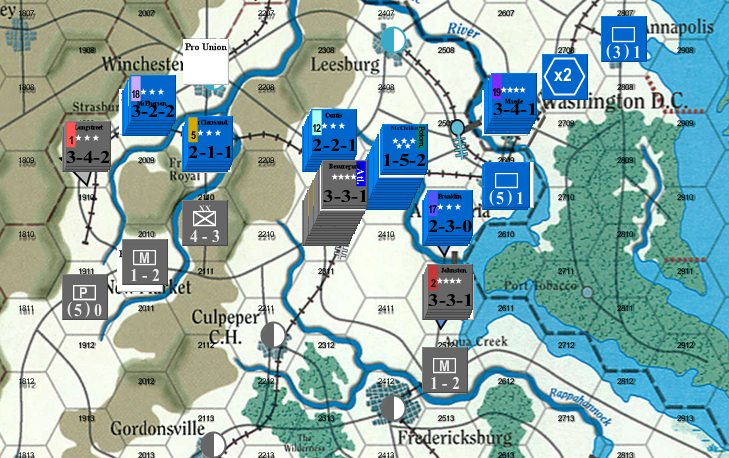
The situation in the Valley before the Union move

McPherson sends a brigade of 2,000 men to secure Front Royal in the expectation that McClernand will be following him down the Shenandoah Valley (or is it up the Valley?).  He then gets after the retreating Confederates with a march attack.  It is on the 900+ column and the 1,000 Confederate are eliminated for no loss.  Longstreet and his now empty corps is displaced and he realises if he goes down the road it is the end of the line.  So he jumps over the river and heads for the hills.

McClernand makes a dash for New Market.  The forced march costs 4,000 men, but New Market is captured for the loss of another 1,000 men (equalling the rebel loss in that important location - it acts as a supply source).

Halleck is told to head down the Chattahoochee and meet up with Hooker.

Pleasanton is told to eat a hearty breakfast and then go get those partisans.  The subsequent march attack sees the partisans destroyed, but for the loss of a 1,000 troopers.  However, as Pleasanton is sitting down to write his report, a Southern fanatic rushes up to him and stabs him through the heart.  This is the third fatality for the Union side (although nothing compares to the death of Lee on the Confederate side).

Grant doesn't feel like moving.  Does he possibly have a hangover?

Crittenden stays put as well, as does Banks and no one even bothers to ask about Pope.

McCook gets the railway line repaired.

Buell cowers by the banks of the Mississippi.

Sumner gets moving in Missouri. He positions himself between Ironton and St Louis, well placed to react to any partisan activity should it eventuate.

Hooker, hearing that Halleck is coming to join him, doesn't move from Fort Gaines.  Maybe he is watching out for what Bruckner might do?

Lyon advances on Richmond.  He has a supply problem, but he has a plan.

Burnside is sulking in Baltimore.  The Confederates had said he was going to command an army.  Instead he finds himself in charge of a desk, and it's not nearly big enough!

McClellan stirs, pushing Franklin's Corps between Beauregard and Bragg.  But will he attack? No.

Keyes old corps is disbanded (saves me trying to work out if Longstreet and his empty corps are affected by it).

In the east the Confederates are in trouble.  Bragg is ordered to pull back to Fredericksburg.  Beauregard falls back, but is not sure where to stop.  He sends some cavalry to slow the Union in the valley and positions himself in Gordonsville.  There is no word from Longstreet who is hiding out in the Massanutten Mountains.

Taylor takes the initiative to reinforce West Point, having guessed that Lyon might need to make that place, with its access to port facilities, a supply base.

Hindman pulls back to defend Richmond.

Hill heads down the Chattahoochee shadowing Halleck who is on the opposite bank.  Bruckner is stuck looking for his train ticket, having been delayed by an over zealous conductor.

Jackson thinks about confronting Grant before he can meet up with either Buell or Crittenden.  Trouble is he has only 22,000 men to Grant's 24,000.  He does it!  Later he fails to attack.  The old taunts of "no action Jackson" come back to haunt him.

Forrest sends cavalry to recapture Marion.

 On to Richmond!

The Hook Up

Week 71

The Union get the 1 chit.

Beauregard decides to send D Hill back to Culpepper Court House, again just to delay the Union in the unlikely event that they advance.  This also allows the 4,000 men from Front Royal to rejoin the Confederate army.

Bruckner is ordered to Columbus.  He hopes to meet up with D Hill, but the latter is unexpectedly delayed.

A Johnston pulls the cavalry back from Marion and into Memphis.

Jackson attacks!  It's on the 91-110 column of CRT 4.  The Confederate stock up on ammo, the Union fix bayonets.  The outcome is horrific.  The Union lose 25% of their army, 6,000 men.  But for the Confederates the losses are much higher, 9,000 men, 40% of their army.  Jackson narrowly avoids being killed, by his own men.

Longstreet, now known as Lostreet, burns his Corps' papers and prepares to be captured.  This will stop the Union from getting a political point, but...  I'm going to rule that the actual destruction of all the troops in the corps represented a decisive victory [25.31].

The Union tell McClellan to go get those Rebels while they are on the run.  He pushes Curtis across the Rappahannock and Franklin down to Aquia Creek.  He then takes the cavalry and storms into the valley, forcing the rebel cavalry to retreat.

McPherson provides a brigade with a packed lunch and sends them off to the mountains to apprehend Longstreet.  They find him sitting quietly under a tree, waiting for them.  There are only so many nuts and berries a general cares to eat.  McPherson then takes the rest of his army and overwhelms the Confederates at Staunton (the other supply source in the valley).

None of the other Union generals in the east make a move except Lyon who attempts to storm into West Point.  He is stopped, but not before 1,000 men perish on each side.

Hooker gives up waiting for Halleck and destroys the rail connection at Fort Gaines before moving to Albany and doing the same there.

Crittenden forces marches to the Tennessee, 1,000 men are lost in the process.  Grant force marches to meet him and loses 2,000 men.  No one else in the West does anything.

In a bloody affair Lyon attacks across the York River and seizes West Point, inflicting 1,000 Confederates casualties, but losing 4,000 men in the process.  At least he now has a place that can be used to land supplies and perhaps reinforcements.

Week 72

The Union get the 4 chit.

McPherson is ordered to Charlottesville where he cuts the railroad.

Over in the West, Banks is ordered to the Alabama River which he reaches near Blue Mountain.  Halleck is told to keep heading down the Chattahoochee, which he does, reaching Eufaula, which he discovers is misspelt on the map.   The 1st Cavalry Corps is sent to Savannah, TN, on the Tennessee river opposite Pittsburgh Landing.  It is hoped that Grant can make some use of it.

As it turns out, none of the Union generals in Tennessee feel like moving.  The weather must be bad.  Maybe it's gonna be a harsh winter? 

Hooker moves back to the Chattahoochee and is now on the opposite bank to Halleck, exchanging pleasantries.

Lyon conducts a march attack against Taylor, capturing Urbana.  Both sides lose 1,000 men.

Both Curtis and McClernand are itching to do something, but it is best that they stay where they are, keeping the rebels hemmed in.  Burnside finally comes to his senses and starts to do the job required of him, collecting all the Union troops scattered across Maryland.  It will be a long job.  Meade stays in Washington expecting a promotion.

Lyon attacks, Taylor's residual troops are wiped out.  Taylor flees but Lyon stays put, conscious of his supply situation.

Curtis attacks D Hill at Culpepper Court House on the 201-250 column of CRT 2.  He didn't need supply, but the Confederates do, but they don't have any.  The battle shifts to the 401-900 column. The Union suffer 5% casualties (2,000 men).  The Confederates lose 20% which, given their supply situation, comes to 8,000 men.  Curtis is wounded and out of action for 11 months, but he has done his country proud.  The Confederates retreat.

Beauregard thinks about counterattacking the now leaderless Union force at Culpepper, but that would leave McPherson in his rear.  Retreating is risky as not all forces can be guaranteed of moving.  He finally settles on using his cavalry to screen the Confederate position.  It will be winter, Confederate reinforcements are coming, they just need time.

A Hill completes his move to join Bruckner.

Jackson thinks about retreating, but can't make up his mind what to do.

Everyone else stays put.

Grant and Jackson in Tennessee standoff

 Chattahoochee hook up.

 The blue cloud coming down on Richmond.


Casualties


This month the losses on both sides were 25,000 men. 

Romans

I am now nearing the end of my quest to field a Roman Army to fight my Ancient Britons.  These 12 figures complete all the legionnaires I need for a Marian Roman Army, only issue is they have the wrong shield shape.  I'm not so concerned about that as they also double up for the Early Imperial Roman Army.  More importantly I wanted to use the Airfix Roman figures as is (even though I've repositioned the shields).


To finish the Marian army I need two stands of light infantry.  Figures have been selected and conversion is about to commence.

For the Early Imperial army, the same psiloi are required, and to do the full list some auxilia (but I'm thinking of just using the archers I have painted and based, although I do have a more auxilia type figures identified for conversion); a warband, but have to be careful if I just use the Ancient Briton figures; a light horse stand, which I have, but may not be perfect; and an artillery base, which might be fun to scratchbuild, but might be more sensible to buy (or at least look to see if the option exists).

Plus I need two camps. 

Then I will be ready for DBA in 20mm or 1/72nd scale.

Thursday, October 5, 2017

Success on the third attempt

Last night at the club I enlisted Mark B as the Prussians and Stephen N as the French to do a further test of built-up area (BUA) fighting in Napoleon's Battles.

One regiment of Prussians started deployed in one village,
while a second regiment was ready to move into the other village.
Two French division were tasked to take the villages.

The BUAs would provide a +2 combat bonus for deployed units that were not disordered.  They counted as rough terrain due to the presence of the stream running through them.

 End of the first turn and there was some fire combat, but no melee.
Both sides had a unit contesting the eastern village.

 The French attacked in the eastern village where both sides were in column.
They successfully withdraw after becoming disordered.

 In the western village the French deployed their light infantry brigade into line and attacked.
It was dispersed when trying to withdraw when it took an extra 4 casualties after suffering 3 casualties in the close combat and 1 casualty in the previous turns fire combat.

 The Prussians attack the other French brigade contesting the eastern village.
The Prussians are routed.

End of the second turn and the Prussians still hold the western village,
but the eastern village is being fought over.
The Prussians have some reinforcements.

 The French attack the western village.
They are successful.

 The French have occupied the western village, but are disordered.
The disorder represents the confusion caused by house to house fighting and also the distance the unit has had to notionally travel to clear out the enemy from the BUA. 
The Prussians counter attack, but are severely repulsed.
While the French were disordered and did not get the advantage of the BUA's combat modifier, they did count as being in line (deployed for fighting).

 End of the third turn and the French now hold the western village.
The eastern village has seen some fire combat, but that is all.
The French have received reinforcements as well.

 The French attack the Prussians in the eastern village.
The French are pushed back, but still cling to the village.

 End of the fourth turn.
The Prussians have been trying to rally their men for more attacks.

 End of the fifth turn.
The turn just saw some ineffective shooting, but the Prussians are now in position to attack.

 The Prussians attack the French in the eastern village.

 And in the western village.

 End of turn six and the Prussians have recaptured the western village.
The eastern village remains contested.

 The French launch a counterattack on the western village.

  End of turn seven.
The French have captured the western village again.
But have been thrown out of the eastern village.

I was very happy with the outcome, plenty of two and fro action and testing of both fighting in BUAs deployed and as just a bit of terrain.

Wasn't so happy with the withdrawal rule.  I think it should be considered part on the melee combat. 

Also used a house rule that allows for position of friendly commanders after all friendly combat units have finished moving.  This stops command units unnecessarily blocking troop movements.

Tuesday, October 3, 2017

WBTS via Vassal - Weeks 65 to 68

The Union carry forward 82 supply, and receive 200 and then 90 for captured town supply, which gives them a total of 372 for 40 personnel points, yes, they have called for more volunteers, even though this meant giving the Confederates 2 Political Points.

The Confederates carry forward 38 supply, have 60 for Major Cities, 4 from seaports and 159 from town supply; a total of 261 for 50 personnel points.

The Confederates augment three 3-3s to 10-3s, raise a small cavalry division, 2-4, a supply train and 22 garrison factors.  They have 147 supply left.

With their new volunteers the Union fill out five 3-3 divisions to 10-3s, and build a River Flotilla and a Naval Flotilla.

The Confederates deploy an 8,000 strong infantry division to Memphis, put a 5,000 garrison in Richmond, an ironclad to New Orleans for fit out and have 14,000 militia ready to deploy during the month.  Tyler joins the Confederacy in Richmond, while Forrest appears in Memphis to take command of the 2nd Cavalry Corps with orders to "give them damn Yankees hell".  A Johnson takes command of the Army of the Mississippi.  No partisans appear, although potential is created in Missouri.  Beauregard officially takes command of the Army of the Atlantic, thanking Breckinridge for his period of acting army chief.

The Union deploy a 10,000 strong division in Bowling Green along with 2,000 cavalry troopers.  A River Flotilla is launched at St Louis, but the new ironclad hasn't yet completed fit out.  The hoped for Army HQ for Grant was not forthcoming.

Union supply costs 55 and 11 rail.  They have 92 supply left and 29 rail.  Supply distribution sees 20 supply sent to depots and wagons using 9 rail.

Confederate supply costs 28 and 5 rail  They have 119 supply left and 20 rail.  They distribute 35 supply using 9 rail.

Kentucky militia are raised in Bowling Green and Missouri militia are mustered in St Louis.

Week 65

The Union get the 4 chit.  Jackson had a 50% chance of taking out Pope and the railroad repair unit, but now he will escape.

Pope is ordered to Nashville (by train).  Pleasanton is ordered to take his cavalry corps and make a further cut to the railway between Tupelo and Corinth.  Crittenden is ordered to recapture Huntsville.

Over in the East Keyes is encouraged to get on with clearing the valley of rebels.

McClernand, not wanting to be left out, moves into the valley as well, but starts to exit via Front Royal.

Lyon cuts the railway at Norfolk and then gets back on board and sails to recapture New Berne.

McClellan thinks really hard about attacking, but the forecast indicates a chance of inclement weather and so he thinks he better wait.  However Keyes attacks and both sides lose 1,000 men.

Back in the west, Halleck stirs, cutting the railway line north of Atlanta and then moving towards the west of that city.  Hooker is tempted to march north to join Halleck, but is concerned about what Bruckner could get up to if he does, so he stays put.

Both Grant and McCook stay put in Bowling Green.  Buell doesn't move either.  The weather must be bad.

In the far west Sumner has forgotten there is a war on.

The Confederates order Jackson out and send Forrest in.  These are two good leaders, the challenge will be how to use them given the limited troops.  As it is, Jackson's retreat cost 1,000 men.

D Hill arrives at the Army of the Atlantic.  A division is sent to plug the hole south of Front Royal.

The four generals around Richmond are confused by Lyon's departure.  "What are supposed to do now?"  they are heard to plaintively ask.  New kid on the block, Taylor, is given command of a brigade and told to recapture Norfolk.

At Atlanta, A Hill splits off a brigade to block Halleck's advance to the west.

Buckner figures that militia need to be placed to stop further Yankee coastal incursions.

Hardee sees that Forrest is a little a exposed and lends him 6,000 men to ward off any march attacks Buell might plan.  Everyone else stays put.

Militia are raised in Jackson,TN; Columbus,MS; and Ft Gaines and Brunswick in Georgia.  This still leaves 8,000 militia in reserve.

Week 66

The Union get the 4 chit again.  I'm struck with indecision about which theatre to concentrate on. Based on the poor quality of the Western generals, it better be the West.

Buell is ordered to attack Hardee.  The march attack goes in on the 91-110 column of CRT 1 and just results in contact.  Pleasanton is ordered to pull back to the outskirts of Jackson.  Halleck is ordered south to threaten both Newman, GA and Talladega, AL.

Crittenden doesn't move, but Banks comes down to the Tennessee. Grant comes down to the Cumberland.  McCook arrives in Nashville and has a chat with Pope.  Sumner pulls back to Rolla.

Lyon is suffering from seasickness and decides to stay in New Berne.  Hooker therefore waits in Tallahassee as he had hopes of linking up should Lyon come south.

Buell now attacks Hardee, it's on the 161-200 column of CRT 1.  It is a bloodless battle, but Hardee is forced to retreat.  Buell, as an Army commander, is saved the embarrassment of becoming a casualty, yet again.

In the East Banks is told to push on clearing the valley.  His march attack causes 1,000 casualties a side, but does not dislodge the Confederates.  The other generals display no initiative to move, but will they attack?  No.

After some thought of sending troops west, the Confederates in the east decide to send Longstreet with 6,000 men to the valley.

Forrest is order to support Hardee and to drive them tha Yankees away from Memphis.  Jackson is also pulled back towards Memphis, arriving at Corinth, which yet again changes hands.

A Johnston in Memphis frets about what to do, but Huger takes the initiative and sends reinforcements to Hardee.

In the Trans-Mississippi, Polk does nothing.

Floyd follows Polk's lead and does nothing in New Orleans.

Buckner decides to pull out of Florida.  There will be militia deployed there he hopes.

A Hill quickly sends a brigade to Newman to block Halleck.

The generals around Richmond display no inclination to do anything.  The generals north of the Rappahannock hold their ground, confident that the Union seem incapable of attacking.

As Buckner hoped militia are raised in Jacksonville, FA.  They also appear in Talladega, AL and Memphis, TN.

Forrest attacks Buell on the 91-110 column of CRT 4.  Both sides use supply.  The Confederates suffer 25% casualties (10,000) to the Union's loss of 8,000 men (20%).  Forrest's horse slips in a pool of blood, but he manages to jump off and avoid being crushed by the poor beast as it falls.  The piles of bodies soften the horse's fall and it is able to get up again, no harm done.  Buell does not retreat.

 Possible stalemate in the East

 Looks promising, but troops moved by water cannot move out of supply. 
So no big inland moves (except if a navigable river is secured).

 The West and possible war of attrition for Memphis.

The Deep South.
The Chattahoochee is a navigable river,
or possibly a dagger into the heart of the Confederacy.

Week 67

The Union get 1 chit giving the Confederates a back to back move and the ability to complete their previous week's maneuvers before the Union can react.

Longstreet arrives in the valley and should make sure that the Union are blocked from getting any further this way.

Jackson force marches (without loss) to get ready to attack Buell.  A Johnston and the Army of the Mississippi stays in Memphis, trusting the fighting to his very capable subordinates to whom he sends reinforcements.  The other generals out west are happy to see Forrest and Jackson do the fighting, as long as they can share in the glory afterwards.

A Hill, busy defending Atlanta from an elusive Halleck, sends a brigade down to Columbus, GA.  Bruckner is happy to rest by the Satilla River.

Taylor and Hindman are paralysed round Richmond with tales of the eminent Lyon's imminent return.

Beauregard, Bragg and Breckinridge rest easy knowing that with the Army of the Potomac in McClellan's hands they will come to no harm, unlike Buell...

Forrest and Jackson declare attacks.  It will be Forrest first and then Jackson giving Buell the ole one-two.  Forrest's attack is on the 91-110 column of CRT 4.  Both sides keep their cavalry out of the engagement.  No supply is consumed.  The Confederates lose 2,000 men (5%) and the Union 3,000 (10%).  Buell retreats but this still leaves him in reach of Jackson's attack which goes in with the same odds.  Both sides us supply this time.  Jackson inflicts 4,000 casualties on Buell (15%), but suffers 6,000 men lost (20%).  Buell voluntarily retreats.  The Confederates congratulate themselves that no senior officers officers became casualties, pity they can't say that about the rank and file.

The Confederates deploy their final 2,000 militia to Richmond.  They wear badges saying "Don't Feed The Lyon".  Someone points out this is defeatist and that they should be called the "Lyon Tamers".  Time will tell, maybe...

The Union order Pleasanton to Paris on the banks of the Tennessee.  Gunboats are moved to protect him.  Farragut moves his fleet to protect Buell's decimated army.

Grant reaches Waverly on the Tennessee.  McCook sends Grant 10,000 men from Nashville.  Crittenden advances cautiously on Decatur, AL while Banks looks on.  Further east Halleck plans his march down the Chattahoochee.  Hooker ain't gonna wait, he's marching up the Chattahoochee.

Lyon is enjoying the sea air and those rumours in Richmond seem to be wrong, he's not moving.

Keyes conducts a march attack on Longstreet, both sides lose 1,000 men and Keyes, in pressing the attack, is shot out of his saddle and is dead before he hits the ground.  The other eastern generals seem oblivious to his fate.  No attacks are made.

Week 68

The Union again get the 1 chit.

Jackson is sent back to defend Alabama.  Hardee is pulled back to Memphis, leaving Forrest in Fort Pillow.

A Hill, Polk and Floyd are not moving without orders (Hill is the only one who really has something to do).  Johnston stays in Memphis and hopes for reinforcements, but he knows it will be a few months yet.

Taylor is told to hurry up and retake Norfolk, not that it is of much use with its rail connection wrecked.  Hindman has a futile conversation with Holmes about how best to defend Richmond.

Beauregard kicks back and relaxes.

The Union order Pleasanton to join Grant.  Their situation is not good as they are reliant on riverboats dropping off supplies.

Banks takes Decatur, AL.  Crittendon watches and in Nashville Pope engages McCook in lengthy conversations of a highly detailed and elaborate nature that McCook is thankfully at a loss later to recall.

Buell's army is in a sorry state and it's not surprising that he decides to stay by the banks of the Mississippi and admire the big gun boats.  Nothing else is happening out west.

Lyon returns to Hampton.

The generals around Washington are busy attending the funeral for Keyes.

Possibly the next big chance for the Union.

But if that fails, there's always Grant out West.


Casualties

The Union lost 18,000 men, the Confederates 22,000.