Sunday, August 7, 2022

War For The Union via Vassal January 1863

Hurlbut tries to get back in supply from Springfield, MO.  

Before Grant can contemplate further action against Memphis, he needs Foote to destroy the battery and rebel ships and so block supply along the Mississippi.  The enemy ships take shelter under their guns up on the bluff.  In the first wave, one Union ship is damaged. but the rebel battery is supressed.  However all subsequent waves fail to inflict any damage.  Foot decides to hold position.

Grant sends McPherson to open up the railway line to Corinth and pick up reinforcements that had been abandoned by McClernand.

Sherman moves to cut off Nashville.  The rebel city is now surrounded by Union zones of control, choking off supplies.

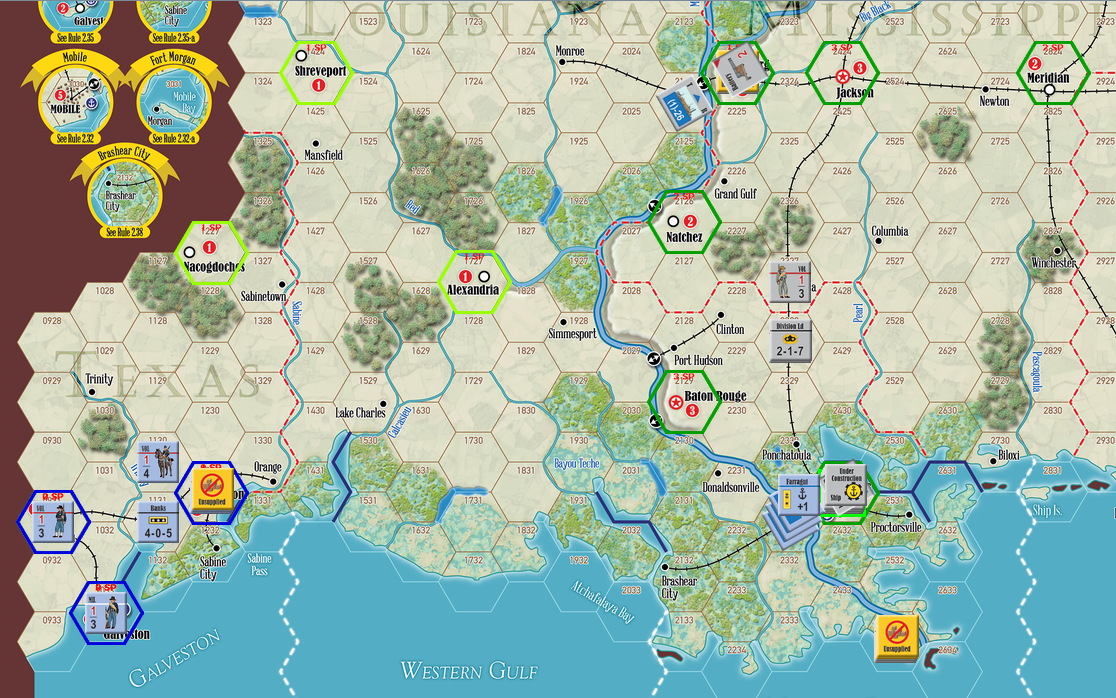
Down south Banks starts to consolidate his position in Texas.

Over East Meade takes command of the troops at Hagerstown,  Rosecrans moves the Army of the Potomac to the icy banks of the Potomac. The US Navy evacuates the militia from Alexandria returning them to Washington.

The navy outside Norfolk bombard the rebel battery.  On the second round the battery is suppressed, but they are unable to make any further damage.  The new ships from Philadelphia attack the new battery at Ft Monroe.  The battery scores a direct hit on the new ironclad.  After one round of bombardment they promptly break off.

Farragut attacks Rebel ships at New Orleans.  The heavily outnumbered Confederate ships are sunk.  Noting that more are being built, Farragut holds his position.

The Confederates move troops to cover the exposed cities and towns on the Mississippi as well as fixing up the battery at Memphis.  A S Johnston and the Army of the Mississippi sit impotently in Memphis.  They have parity with Grant, but daren't risk an adverse outcome if they attack.

J E Johnston at Nashville doesn't have that luxury and moves out to confront Sherman. He attacks at 3:2 with a +2.  The die roll is a 9.  Sherman suffers 10,000 casualties and 2 fatigue and retreats.  The Confederates lose 5,000.  Supply is restored, but Nashville is very, very vulnerable.

Over East Jackson secures Alexandria,  Lee attacks Burnside's 30,000.  The odds are 5:2 with a +2.  The die roll is a 7, the Union lose 10,000 men and retreat suffering 3 fatigue.  The Confederates lose 5,000 and gain 1 fatigue.  Beauregard with 40,000 men crosses the Potomac.

Taylor with 20,000 stays in reserve at Fredericksburg.

The Eastern Theatre is hard work for the Confederates,
they have the upper hand, but not enough troops.
They need to watch for coastal landings
and for the Yankees cutting their supply.

Down Texas way and the Confederates have nothing they can really use to stop the erosion.

The West is too open for the Confederacy to stop the Union from breaking through.


Friday, August 5, 2022

Vikings versus Old Saxons

It started well, but my varied collection of figures from which I had constituted my Viking force, many of which have rarely graced the table, were no match for Dave's old Old Saxons.

The Vikings won the scouting,
but probably should have avoided pitting their large units against the Saxon's equivalents.

The Saxons come down off the hill,
the Vikings start to move out on the flanks.

The Irish javelins start to hurt the Saxons,
the Viking skirmishers are getting in position of the Saxon flanks
but the main bodies are with in charge range.
Who would get the initiative?

Well, despite the Saxons playing Decisive Initiative,
the Vikings won the toss and charged.
As you can see it did them little good.

One more turn and the Vikings are done for!


Thursday, August 4, 2022

War For The Union via Vassal December 1862

Winter returns.  Supply becomes an issue.  40,000 more militia are raised to help fight for the Union.

In a move that has the Confederates screaming for their lawyers, the Union determines it can send more men over seas and provided they are in small parcels, they can "live off the land" (as their is no chance of attrition for 5,000 men on the table).  The only thing stopping the Union is that they did not plan things out and therefore don't have troops in reach that can do serious damage.

Banks gets on with his conquest of Texas.

Hurlbut starts to move troops back towards Springfield to get them in supply.  The troops don't really matter, what this foray into Arkansas has done is tie up a valuable general.

McClernand starts moving reinforcements towards Grant who is camped outside Memphis.  More importantly Sherman opens the rail line through to Grant.

In a sneaky move, Reynolds slips 20,000 militia into Alexandria, cutting off Confederate supply to the forces across the Potomac.  Rosecrans digs in and waits Lee's next move.

Lee pulls back and sends Jackson and 30,000 mean to deal with the Union militia in Alexandria.  It is a 3:2 attack with a +5.  Jackson's luck fails him, the die roll is a 1.  Both sides lose 5,000 mean and gain a fatigue.  

Elsewhere things are fairly static, although troops are being rushed to defend the supply centres that are exposed on the Mississippi (Baton Rouge and Natchez).

In the East the Confederates are back behind the Potomac, with the Union threatening their supplies.

In the South Texas has been occupied,
but the Union may have missed the chance to sail up the Mississippi

In the west things seem to be finely balanced,
although the Confederates are tied to defending Memphis and Nashville

January Interphase

The Union commission a new squadrons of transports in St Louis (essential for creating River Depots) and call up 30,000 militia infantry and 10,000 militia cavalry.  McPherson and Meade receive commissions, but McClernand is sent home. Two squadrons of ships appear at Philadelphia, included one that is an ironclad.

Twenty five precent of Confederate veterans will retire if supply capacity is less that 109.  It is 112 - but if the Union had got its act together and seized Baton Rouge...

The Confederates give Taylor a commission, but remove two divisional level commanders (one of whom was charged with taking troops to Baton Rouge - whoops!)

The blockade of Norfolk is broken.

The Confederates conduct a further recruitment.  They currently have 440,000 infantry and 35,000 cavalry (not counting state militia).  They are able to recruit an additional 25,000 men some of which go to Baton Rouge - phew!!

Confederacy have 12 resource points.


War For The Union Via Vassal November 1862

The Union call up a further 40,000 militia and appoint McClernand and Reynolds (posted to Washington) as well as creating the Army of the Cumberland in Louisville.

In a bold move, Rosecrans takes the Army of the Potomac to meet Jackson.  Hooker is recalled to Washington which is left with a garrison of 60,000.  With 20,000 men assisting from McDowell's command Rosecrans can get 3:1 with a -3 modifier.  The die roll is a 7.  Both sides lose 5,000 men, but Jackson is bundled back across the Potomac with 2 fatigue.  Burnside advances to close the gap.

Down in Texas, Franklin occupies Houston and attacks the rebel militia holding Galveston.  It is a 2:1 attack with a +1.  The die roll is a 6.  Franklin is wounded as is the Confederate commander.  It was a bloody battle with both sides losing 5,000 men which spelled the end of the Confederates in Texas.  Banks takes over a Governor of Texas.

Farragut sends his damaged ship to Fort Keys for repairs and sends a message that he needs infantry if he is to take New Orleans.

The Confederate cavalry retreat before Hurlbut's advance on Springfield which falls to the hungry Union troops. 

Lyon, realising that supply is going to be an issue, but needing to keep the opposing Confederate army occupied, moves slowly towards Nashville, ordering Thomas to join him, which will give him 60,000 men.  The newly arrived McClernand is sent to Columbus to organise the troops that have accumulated there.

Union cavalry occupy Decatur.  Nashville is now at risk of being cut off from supplies.

Troops are ferried to Ft Donelson and in a surprise move, Sherman entrenches his 40.000 men at Corinth (not trusting the Supreme Court, a river depot has been established there) and then slips into a fast boat and sails down the Tennessee to take command of the 35,000 men at Ft Donelson.  He attacks the Confederate blocking force at 4:1 at +1,  The die roll is a 7. The Confederates are wiped out, but 5,000 blue coats bite the dust in exchange.

While all this is happening, Grant keeps watch on Memphis, as Foote brings his ships back up to strength.

The Confederates bring J E Johnston back to take over the Army of Tennessee.  He can either attack Sherman or Lyon, but to do so would leave Nashville open to attack.  He decides to stay put, but sends Forrest to command the cavalry tasked with recapturing Decatur.  It is a 2:1 +2.  Die roll is 4.  It is a costly business with each side losing 5,000 horsemen, but Decatur is secured.

In Memphis A S Johnston faces a similar dilemma and decides to stay put.  Let those damn Yankees take the risk!

A battery starts construction at Vicksburg and some more ironclads are commissioned at New Orleans.

On the Potomac, Lee brings up more troops and shuffles fatigued troops between commands so that he can make a 2:1 +2 attack with 80,000 men against McDowell and his 30,000.  The die roll is an 8.  The Union suffer 10,000 casualties, and collect 3 fatigue as they are bundled from their position.  The Confederates lose 5,000 and gain 1 fatigue, but Lee decides to cross, but not make a second attack (which at best was 1:1 with no pluses on Washington, although he could have a 1:1 +1 attack on the Army of the Potomac.)  With winter just about here he decides a bit of consolidation will pay off.

The threat to Washington increase with Rebels at the gates.
But winter is coming...

The rebellion in Texas has been supressed.

Stalemate in the West.


War For The Union Via Vassal October 1862

In the East the Union are at a loss to know what to do, so they just bring up some reinforcements and dig in a bit more.

In Texas, Franklin attacks the Confederate defenders across the Trinity River.  It is 3:1.  The die roll is a 10.  The Confederates are wiped out, but the Union lose 5,000 men in the process.

Farragut has a go against the New Orleans battery.  One of his ships is damaged, but the battery is suppressed. On the third bombardment the battery is Suppressed Level 2 as well as being reduced which means it is eliminated.

In Missouri, Hurlburt commences the last stage of his march to reclaim Fayetteville.

Thomas attempts to overrun the Confederate cavalry screen, but it retreats.  McCook then tries the same thing and it again retreats,  Finally Lyon comes up and tries to attack the Confederate cavalry, but again it retreats.  It is fatigued, but has held the Union up.

Buell joins Grant and then Grant sends Sherman to retake Corinth.  It is a 4:1 attack.  The die roll is a 9. The Confederates are wiped out with no loss to the Union.  After extensive litigation, Sherman gets his way in claiming that Corinth as a city can function as a legitimate starting point for a LOS which along river hex-sides can be any length.  It is possible and provided that they are not blocked, river hex-sides could function like that.  The Confederates lodge an appeal.  It is this process of double checking the rules which is really bogging the game down unfortunately.

The Confederates know winter is coming and that will slow the Yankee aggression.

S D Lee moves to Clinton where he is still in supply, but able to strike at any Union advance on Fayetteville, AK.

A S Johnston with the Army of the Mississippi at Memphis daren't send troops after Sherman.  The best he can do is order up some cavalry to Tupelo.  

Pemberton leaves a small blocking force south east of Ft Donelson and moves the Army of the Tennessee to Nashville where he now has 75,000 men.  That should be enough to stop the Union at least.

The newly commissioned squadron of ironclads sorties out of New Orleans.  It is heavily out numbered, but not out armoured.  It is after the damaged Union flotilla, until a judge points out that D1 only affects attack strength, not defence strength. A quick calculation show a 50% chance of being sunk for very little gain and the attack is called off before it even starts.  

Lee decides to join Jackson and make a massive attack with his combined force of 90,000 mean against Hooker's 30,000.  The head waters of the Potomac reduce the odds to 5:2 and there is a +2.  The die roll is an 8.  The Union lose 10,000 while the Confederate lose 5,000.  Jackson crosses over this time.  The Confederates have 1 fatigue.  Hooker retreats to Hagerstown, he has 3 fatigue.

Early has been recalled from watching Jacksonville to Fredericksburg.

The Rebels are across the Potomac!
Panic in Washington!!

Texas in peril!

Sherman is on the loose!


War For The Union via Vassal September 1862

The Union call up 40,000 militia.  Heintzelman is appointed (he should have arrived early but I picked Hooker by mistake), but promptly put on the reserve list.

In Texas, Franklin moves to Belmont and reestablishes his base there, receiving 10,000 reinforcements shuffled around from Jacksonville.

Farragut sails up the Mississippi and attacks the battery defending New Orleans.  In the first round the battery is suppressed. The gunners do a good job of ducking as all subsequent rounds miss. 

Hurlbut moves to Springfield, MO. He is confident he will win the race to get to Fayetteville.

Lyon starts a drive towards Nashville crossing the head waters of the Cumberland and ordering Thomas to come down and meet him (and abandoning his thrust to capture Knoxville). There is a cavalry screen before Lyon, but that retreats.

Buell crosses the Tennessee planing to join Grant.  With the return of A S Johnston, Grant has lost his advantage.  He slightly shifts his position and decides to send in the navy.  Foote with 3 squadrons of ironclads takes on a motley, but significant collection of Confederate vessels. After one round of combat two Confederate ships are sunk and one Union ship damaged.  The Confederates withdraw to Memphis.  Foote sends the damaged ship to Cairo to repair.

At great expense on the railways, the Union send troops from the West to man a line from Philippi to Hancock (town that is, the General is yet to appear) to stop any Rebel cavalry running amok.  McDowell is given more men and sent back to the Potomac river line.

The Confederates feel snookered, both east, west and south. The best they can do is rail up reinforcements and try to create blocking or delay points.  The only comfort they can take is that the Union are similarly backed up and winter is coming (and I was reminded that there is a progress VP total the Union need to achieve to avoid instant death). In one bit of good news, J E Johnston has returned and is put in charge of the Army of Tennessee.

The big picture, you need to click and zoom in to see what's happening
or rather what's not happening.

October Interphase

The Union commission a new squadrons of transports in Washington and call up 40,000 militia.  Sherman replaces Banks.

Confederate supply is down 5; 1 for Belmont, 2 for Winchester, 1 for Jacksonville and 1 for the blockade of Norfolk (which is still successful even with the loss of Ft Monroe).  They have 116 in total.

The Confederates conduct a further recruitment.  They currently have 420,000 infantry and 35,000 cavalry (not counting state militia).  They are able to recruit an additional 45,000 men.  Pemberton joins the Confederacy, taking over command of the Army of the Tennessee.

Confederacy have 12 resource points and now have 10.

A squadron of ironclads is launched at New Orleans. 


Wednesday, August 3, 2022

Don't Mention The War - Part 16

After that brief patch of sunshine at the beginning of March 1942 the weather returned to form with snow, rain and storms right up to the start of May/June.  At least this conserves the oil and doesn't impact rail and air rebases.

Schlammkrieg

When they said lightening war they meant quick like lighting not rain, thunder and snow storms.

Production

Germany lent Italy 4 oil and 1 resource.  In a somewhat late move, Germany started to build a unit of marines.  They may be of use in Greece or on the Black Sea or even Baltic and it is only a short hop across the Channel.