Showing posts with label Ancient Naval. Show all posts

Monday, October 16, 2017

Galley Action

Yesterday I umpired a game of Galleys and Galleons between Mark Woods and Michael.  It was Michael's first game with these rules, so things were kept simple, not that G&G is a complex set of rules.

 Mark's flagship and its consorts.

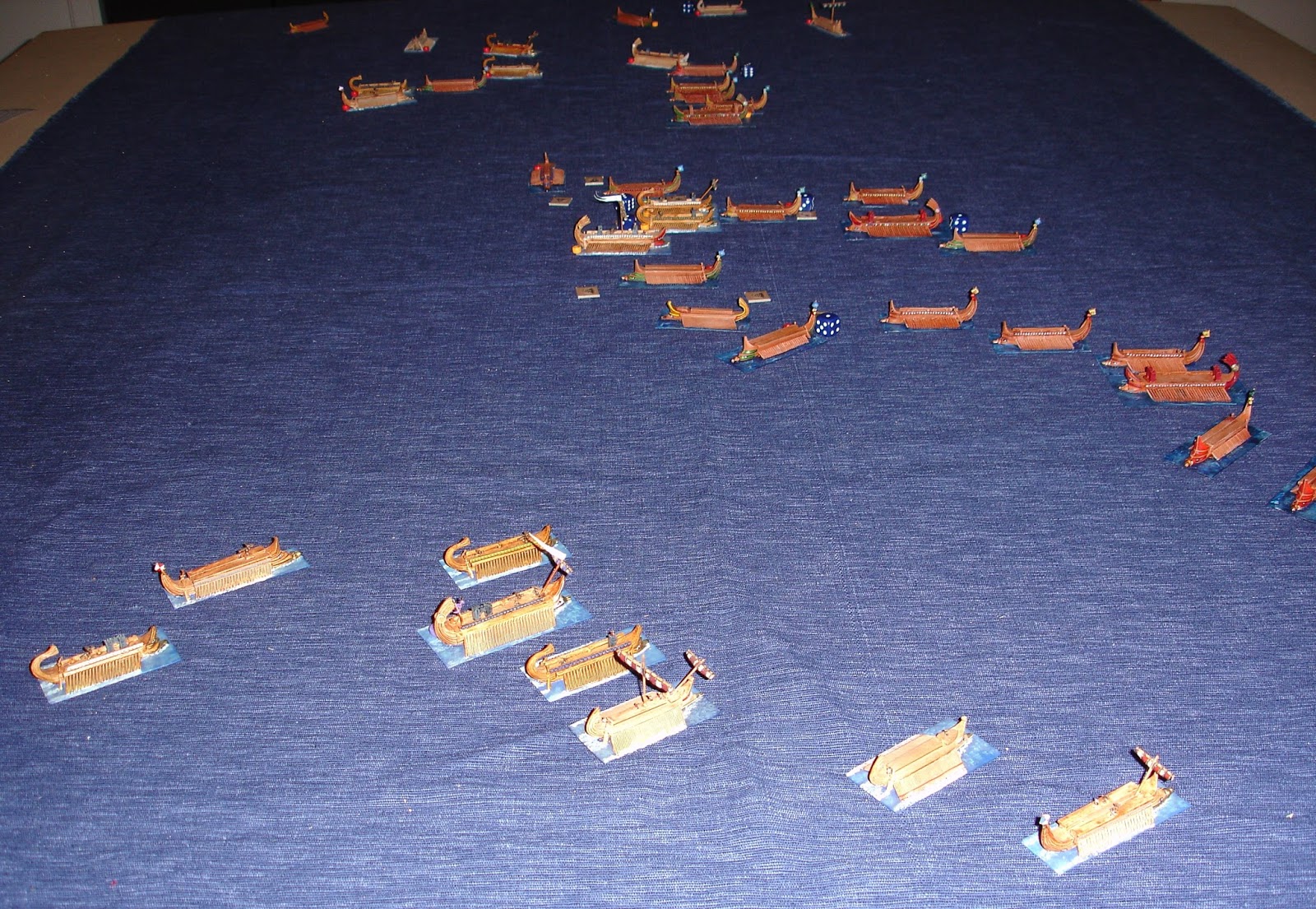
 A frontal ram by one of Michael's triremes inflicted a bit of damage.

 The fleets coming into contact

Each side had 12 ships: one hexareme as flagship (Q4 C5), 5 quinqueremes (Q4 C4) and 6 triremes (Q3 C3).  These were arranged in two squadrons.  Mark was fielding mixed squadrons while Michael had all his triremes on his left (bottom right corner in above photo) and his big ships on his right.

The game played well, with plenty of maneuvering until contact was made.  
The game then became a slugfest, eventually going to Michael.


Sunday, October 8, 2017

Launch of the Quinquereme

I had made this model some time ago.  I didn't do as good as job on it as I had on its smaller companions which I attribute to the larger size being a bit more unforgiving when cutting and glueing.  Once I finished it I decided to add the officer's tent.  Then there was a further delay while I added a tower.  Still more delays while I built a corvus.

 In full sail

 Equipped for fighting

 The corvus actually works, if there was any red fleet ships to board.

Bursting with troops.
6mm Rapier miniatures after a stunning paint job by Mark Woods.

I've some crew figures to paint, but I have yet to settle on how I want to base them.  I am sure the inspiration will come.

Monday, July 17, 2017

Three Liburniums

Three new additions to my fleet.  The Liburniums come three to a page.

I'm really happy how these look.

I did go for some individuality with the masts.

The masts are fully detachable.

I really like how the oars blend with the base.

I am sure to do more.


Tuesday, June 27, 2017

Roman Seas Trireme

After the fun I've had with the Galleys and Galleons rules I have been looking around for some galleys of my own.  Having had some recent experience with paper boats I thought I would give Roman Seas a go.  I'm very happy with the result, particularly being able to crew them with 6mm figures.

Quite a majestic little ship.

I had a few ideas about the masts as I wanted them to be removable.  After looking at all sorts of tubing, Simon suggested reinforcing the hull with balsa.  Hmmm, that's an idea.  I ended up drilling holes directly into the balsa and found that held the masts perfectly.

The base colour was chosen to match the blue in the oar plate.
It is Dulux "Snap-Shot" and a sample pot is going to go a long way, 
although I might need more as the plan is to paint one of the club boards.

Not sure my attempt at weathering the sails has succeeded,
but I did paint the edges of the model in a light blue to match the artwork
and some edges were coloured using black texta.

These 6mm figures look the part.

Perhaps the bamboo skewers are a bit thick, but they will do for now.

Thursday, June 8, 2017

A bit of learning

I'd read a post recently which had mentioned this book The Ancient Fleets: The Story of Naval Warfare Under Oars by John Van Duyn Southworth as being a good reference.  I looked to get a copy and it was on Amazon for $10.  Good buy I thought, even though I knew it was US dollars.


Then I saw the postage...

Well, it would probably still be a decent buy given you can easily pay $50 for such a book here, but with Mr Trump as the face of America I though nah, let's look for other options. 

A search of my local library online system produced gold.


So, saved $50 and will have a reference book in a few days (it's on hold and will be delivered to my closest branch for me to pick up).  Better still, when I'm done with it I can return it to the library for them to look after.

Meanwhile...


I also thought to do a bit of searching on the Internet, specifically Wikipedia.  It has provided me with the basics which I include here from https://en.wikipedia.org/wiki/Galley_tactics:

Introduction of the ram


A schematic reconstruction of a defensive circle of galleys seen from above.
Around the 8th century BC, ramming began to be employed as war galleys were equipped with heavy bronze rams. Records of the Persian Wars in the early 5th century BC by the Ancient historian Herodotus (c. 484-425 BC) show that by this time ramming tactics had evolved among the Greeks. The formations could either be in columns in line ahead, one ship following the next, or in a line abreast, with the ships side by side, depending on the tactical situation and the surrounding geography. There were two primary methods for attack: by breaking through the enemy formation (diekplous) or by outflanking it (periplous). The diekplous involved a concentrated charge in line ahead so as to break a hole in the enemy line, allowing galleys to break through and then wheel to attack the enemy line from behind. The periplous involved outflanking or encircling the enemy so as to attack them in the vulnerable rear or side by line abreast.[2] If one side knew that it had slower ships, a common tactic was to form a circle with the bows pointing outwards, thereby avoiding being outflanked. At a given signal, the circle could then fan out in all directions, trying to pick off individual enemy ships. To counter this formation, the attacking side would rapidly circle, feigning attacks in order to find gaps in the formation to exploit.
Ramming itself was done by smashing into the rear or side of an enemy ship, punching a hole in the planking. This did not actually sink an ancient galley unless it was heavily laden with cargo and stores. With a normal load, it was buoyant enough to float even with a breached hull. It could also maneuver for some time as long as the oarsmen were not incapacitated, but would gradually lose mobility and become unstable as it flooded. The winning side would then attempt to tow away the swamped hulks as prizes. Breaking the enemy's oars was another way of rendering ships immobile, rendering them into easier targets. If ramming was not possible or successful, the on-board complement of soldiers would attempt to board and capture the enemy vessel by attaching to it with grappling irons. Accompanied by missile fire, either with bow and arrow or javelins. Trying to set the enemy ship on fire by hurling incendiary missiles or by pouring the content of fire pots attached to long handles is thought to have been used, especially since smoke below decks would easily disable rowers.
The speed necessary for a successful impact depended on the angle of attack; the greater the angle, the lesser the speed required. At 60 degrees, 4 knots was enough to penetrate the hull, but this increased to 8 knots at 30 degrees. If the target for some reason was in motion towards the attacker, less speed was required, especially if the hit came amidships. War galleys gradually began to develop heavier hulls with reinforcing beams at the waterline, where a ram would most likely hit. There are records of a counter-tactic to this used by Rhodian ship commanders where they would angle down their bows to hit the enemy below the reinforced waterline belt. Besides ramming, breaking enemy oars was also a way to impede mobility and make it easier to drive home a successful ramming attack.[5]

Boarding

Despite the attempts to counter increasingly heavy ships, ramming tactics were superseded in the last centuries BC by the Macedonians and Romans who were primarily land-based powers. Hand-to-hand fighting with large complements of heavy infantry supported by ship-borne catapults dominated the fighting style during the Roman era, a move that was accompanied by the conversion to heavier ships with larger rowing complements and more men per oar. Though effectively lowering mobility, it meant that less skill was required from individual oarsmen. Fleets thereby became less dependent on rowers with a lifetime of experience at the oar.
In fact success in ramming depended so much on a combination of skill and good fortune that it played a somewhat subordinate part in most ancient sea fights. The Romans baffled the ramming tactics of the Carthaginians by the invention of the corva, or crow, a plank with a spike for hooking onto enemy ships which grappled the prow of the rammer, and provided a gangway for boarders. It's not certain whether the weight of this weapon destabilized Roman ships and led to whole fleets being lost in storms. The Romans did continue their boarding tactics in the naval battles of the Punic Wars, but are also reported as ramming the Carthaginian vessels after the abandonment of the corvus. An older and alternative way for boarding was the use of grappling hooks and planks, also a more flexible system than the corvus. Agrippa introduced a weapon with a function similar to the corvus, the harpax.

This entry, https://en.wikipedia.org/wiki/Hellenistic-era_warships, also provides an explanation of the various ship types:

Sunday, May 21, 2017

Just the Galleys (and a fish)

For the clubs games day Mark Woods and I arranged a game of Galleys.

And fish.

Where's the fish?

Phoenicians on the left (myself and Stephen B) and
 Greeks on the right (Mark Woods and Stephen N).

The Stephens had the left wing squadrons in each respective army.  The Marks took the centre and right wing squadrons.  We used playing cards to represent each squadron and shuffled each turn so now one new who was going next (except person who went last in a turn couldn't go first in the next turn).  This system worked well.

Beautiful Xyston models.

Here's the fish, or rather monstrous sea creature.

And it takes a fancy to one of the Greek quinqueremes.

The Phoenicians get first hit with a successful ram 
(marked by the green dice in lieu of tasteful damage markers)

The Greek quinquereme fights back, miraculously setting the fish on fire.

The two fleets (each comprising three squadrons)
are now engaged.

Ram and counter ram.

But some damage is caused by shooting 
(the quinqueremes are armed with Scorpios for long range combat)

The Greek flagship looks a little nervous
(big ship in the top middle of the picture looking lonely)

Killer Trihemiolia which have worked round the Greek left flank
and represent a tandem killing machine.

The Greek flagship was rammed and then shot up.
The Phoenician flagship landing the killing blow 
(skillful rolling of a six by me to Mark's four).

The right of the Phoenician line.
Three Quinqueremes holding firm (they did precious little else).

The action viewed from the Phoenician left.

Tally

Phoenicians lost 4 Triremes and 1 Quinquereme.  
Greeks lost 8 ships (including Flagship and one to the Big Fish).


Thursday, May 11, 2017

Galleys and Galleys and Monster Fish

Today Mark Woods and I did a bit of test (or retest) of Galleys and Galleons for Ancient naval warfare as we plan to run a big game for the next NWS games day.

Two evenly matched fleets deployed in two squadrons per side, as seen from my opponent's side.

Each force had: 
  • 1 Royal Flagship Q4 C5
  • 4 Quinquereme Q4 C4 
  • 3 Trihemiolia Q2 C2
  • 3 Trireme Q3 C2

All were considered to have bow and javelin shooting out to one short all round (no modifier) and the quins and flagship had Chaser Guns, eh, I mean Scorpio.  We thought of having different rules for catapults but decided it was getting unnecessarily complex.

And Mark Woods gets off to fine form on his first activation roll.

We used playing cards to represent the squadrons, he was King and Jack of Spades and I was King and Jack of Hearts.  Simple system works well for multiplayers as well.

My first activation was a bit of a fizz as well.

And then it got interesting...

The Hearts claim first sinking.

The Monster Fish, sometimes played by Simon who had joined us, has a chomp on one of my ships.

Lots of action.
One of the Spade's ships has even caught on fire.

That damn fish has come back for another bite.

End of game.

The Hearts lost two ships sunk and one captured.  The Spades lost two ships, captured one, but have three ships crippled.  The fish is still hungry.

I'm still amazed how well this rule system works and how adaptable it is.  

All that is needed for our big game is a tailored QRS and some ship identity cards.

The fish is truly ancient, having been in my family for as long as I can remember.  My guess is it was a souvenir from one of mum or dad's travels in the 1950s, possibly even earlier.  I reckon its Italian and therefore possibly mum's from the 1950s or maybe dad's from the 1940s.  Pity they are not around to ask, but I am sure they would be happy to see it still is around and bringing fun.

And I can't mention fish without referencing this:


Enjoy

Friday, March 3, 2017

Greek Galleys a Go Go with Galleys and Galleons

Today Mark Woods and I tried out Galley and Galleons with 24 galleys aside, organized into three squadrons each.  Each squadron had a Royal Flagship (large polyreme Q4 C5), three Quinqueremes (Q4 C4) and either three or two Trihemolia (Q2 C2) or three or two Triremes (Q3 C3).  We used the rules as they were except that a differential applied in ramming if there was a difference in damage factors between the ships (i.e. an undamaged ship ramming a damaged ship would have a -1 benefit.  If the target had two damage this would give a -2 benefit.)  This turned out to be very effective and perhaps should just have been a max -1 in line with the factor that applies to the difference in combat factors.  But damaged ships would be much more susceptible to ramming or in their ability to ram ships that had lesser or no damage.  It also produced results as causing excess damage by ramming sinks the ship (my interpretation).

The fleet of Admiral Mikalis arranged before the fleet of Admiral Desaki

The galleys starting rowing cautiously towards each other

Seen from the right of Desaki's line.

And from the right of Mikalis

The centre squadrons were in action first with Mikalis' Quinqueremes getting in some long range shots from their catapults and other mounted engines of war.

A failed activation saves a Mikalis ship from a potential ram.
We had a number of these "events" and it lends well to the excitement of the game. 

Mikalis' ships get the first strike against the Desaki's centre, 
smashing a ship to bits

By now the centre is heavily engaged and one flank is also getting into action,
 but the other flank seems somewhat reticent.

A full on Yahtzee!
Both ships suffering oar damage.
Maybe head on rams should be more about oar rakes?

Note: The black dice (okay, dark blue) represent accrued damage.

The Desaki centre is shrinking or is that sinking?

The Desaki right are slow to get in position.
This is good as the opposing Mikalis ships have been very tardy.

But now they are approaching.

The ships on the other Desaki flank are maneuvering around the Mikalis ships.

The destruction of the Deskai centre continues.

Note: the coloured beads (or absence of) denote the different fleet squadrons.

One of the Mikalis ships is on fire.
The critical hit table might need a revision for ancient galleys.

The distant flank.
Mikalis ships still trying to get into line.

The Desaki's centre has been destroyed, 
just as they started to make some progress with their left
and even get their right into action.

The game played remarkably well.

I continue to be impressed by the Song of Blades and Heroes mechanics.  While 24 ships a side might be challenge, the game played without difficulty (except I could have done with a summary of the rules as they applied just to galleys as being an itinerant player I had to look up a number of things, not just because I'm a rules pedant, but I wanted to confirm I was basically playing the rules as written for future reference).

We didn't have any terrain (obviously), but one option would be to replace sunk (more accurately wrecked and/or floundering ships) with base sized makers that would then denote shallows or equivalent hazards.

Lots of fun and great to be able to use the stunning 1/600th scale models by Xyston.

Thanks Michael for the loan of your fleet, it did you proud!