Friday, September 18, 2015

Combined Arms Attacks Using Napoleon's Battles

What follows are three combined arms examples.   French infantry faced by Prussian infantry and cavalry.  1815 factors will be used.

Example 1


At the start of the Prussian move the French are over 400 yards away.

The Prussian infantry advance to within 90 yards, pinning the French.

The Prussian cavalry charge home.  The French will get to fire at the cavalry.  They will receive fire from the Prussians.  The French, with six bases giving them a +1 offsetting the -2 for being unprotected against attacking cavalry, have a overall -1 modifier and that gives them a 20% chance to disorder the Prussian cavalry.  The Prussian infantry have a 0 modifier and a 25% chance to disorder the French.

If no one is disordered the French will have a combat factor of -4 plus 1 for mass, giving them -3 against the Prussian cavalry on +4.  The Prussian need to do five casualties to rout the French.

Assuming no disorder the French factor is -3 and the Prussians +4.

62% French Rout 
28% French Disorder, Prussian cavalry bounce
9% Negligible outcome, Prussian cavalry bounce
1% Prussian cavalry bounce disordered

Example 2


This time the Prussian cavalry move first.

The French fail to form square (they had a 70% chance of succeeding).

The Prussian infantry advance to give fire support (being careful to position the French in their left fire zone, something I haven't quiet clearly done in the picture) and the factors are the same for Example 1.

Example 3


The cavalry move first.

The French form square.

In go the Prussian infantry.

This time both sides have a 0 fire modifier so a 25% chance to disorder the other side.  The French would pick the Prussian infantry as the target as that would be the modifying unit.

Assuming no disorder the French factor is -4 and the Prussians -1.

26% French Rout 
29% French Disorder, Prussian cavalry bounce
31% Negligible outcome, Prussian cavalry bounce
9% Prussian infantry disordered, Prussian cavalry bounce
5% Prussian Infantry rout, Prussian cavalry bounce

Applying the new optional Combined Arms Attack rule in NB IV (11.13 page 92) gives the Prussians a 60% chance of joining the combat.  The Prussian player can avoid this by launching his cavalry in react phase.  If the French fail to form square then the outcome is as for Example 1 and 2.  If they do form square then the Prussian cavalry will bounce.  The factors are French at +8 and Prussian at -1.  The worst die roll outcome is a tie and one casualty each.  The following movement phase sees the Prussian infantry hit the French in square.  To avoid this you would have to employ the optional Emergency Lines from Squares rule (11.9.2 page 89) which would give the French a 40% chance of forming line.

There is also the issue of allowing a unit to close to within less than 100 yards if it was not going into close combat.  However they are bound to be lots of legitimate moves that would place units within this range and pin the enemy.  Then it would become an issue of only being in combat contact that would pin.

The reality is that the Prussians have used two units to try and take out one French unit.  At best they have a 62% chance of success.  Meanwhile, what are the rest of the French forces doing?

This is the chart for the melee outcome percentage calculations:

Thursday, September 17, 2015

Who will stop the boats now?

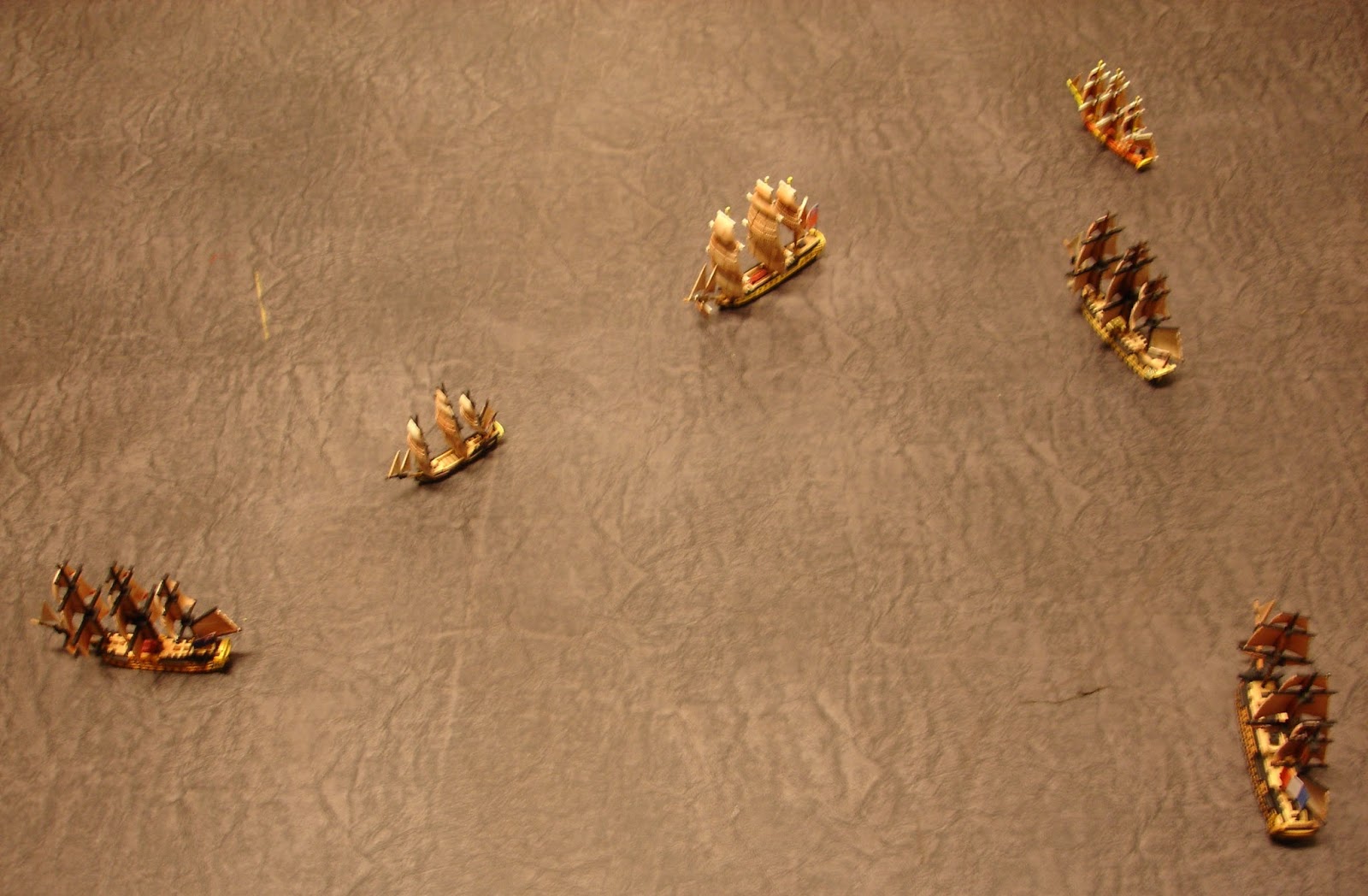
A repeat of the blockade running scenario.  Mark B, political appointee, commanding the blockading forces of his Majesty King George tries to stop the French commanded by Matthew, one of the best French commanders with a rating of "middling".

Forming the blockade line, from left to right HMS Defence, the flagship, HMS Meleager and HMS Spartiate.  The French need to exit from the top left hand corner.  The frigate Unite leads the way, follwed by Imperial, the flagship, and Aquilon. 

The British are holding position and using their gunnery skills to fire, somewhat ineffectively, at the French as they slowly make their way around their rear.

The French start to return fire.

The British line breaks, with damage to both HMS Meleager and HMS Spartiate.

The British fight on, land a many a broadside on Aquilon.

Aquilon gives its fight to stay a float and sinks beneath the waves (mostly, a goodly amount of wreckage is left bobbing on the surface).

HMS Defence heads to cut off the French.  It delivers a devastating bow rack to the little French frigate, but then sails off into the mists of the table edge.

The British frigate is out of it, but HMS Spartiate fights on, despite significant damage.

The French frigate, gets away, but not in the best shape or direction.  The Imperial however completes the task and sails off to open waters.  HMS Spartiate is in no condition to give chase and sails off into the mists.

While I made a few mistakes (getting clockwise confused and failing to add in factors) they applied equally.  No explosions this time, but a good number of failed turns which probably helped the French except that the British were generally "in irons."

We just used an eight point compass which made wind direction much easy to track on the square table with its four sides and four corners.  I need to make some wrecked ship models and things always look better with some cotton smoke.


Sunday, September 13, 2015

Waterloo Take Two - The Setup EXTRA PHOTOS

Mark B supplied these


Waterloo Take Two - The Set Up

It took about two hours to do but we are ready to.  Just have to find what I have done with General Foy.

We will be using the new edition of Napoleon's Battles "selectively".

Looking north towards the Allied lines

Looking east and trying not to notice the supposedly invisible tape.

Looking south towards the French

Looking west from where the Prussians will arrive.

Value for money

I have had the new edition of Napoleon's Battles in my possession for a day I thought the first question I would ask would be: Is it value for money?


There are two aspects to the answer: how does it compare to other products and does it give a good game.

This post will look at the comparison with other wargame rules that I have purchased recently (last five years give or take).  As to whether it gives a good name, it is easy to just look at the number of AARs I have made referencing the rules.

So what do I have to compare it to?  DBA 2.2, Line of Battle, Blitzkrieg Commander, Galleys and Galleons, Saga, Field of Glory, Blucher and Regimental Fire and Fury are the most recent rule acquisitions.  The other important reference point is the other editions of Napoleon's Battles - I have the 1st Edition by Avalon Hill and the 2nd Edition by Five Forks.

The Avalon Hill edition is a classic.
(For the record: 116 pages, b&w, three A4 softback booklets in a box with various player aids)

The 2nd Edition (176 pages, b&w, A4 softcover) I recall took forever to arrive, was of poor quality and had two major changes: withdrawal became a standard rule, not optional (something I've only just come around to accepting); and, most importantly, fixed the flaw in the pin rule were a cavalry unit could pin an infantry unit and stop it from forming square when charged by a second cavalry unit.  The Marechal Edition is certainly better than the 2nd Edition, but clearly not a ground breaking new rule set as represented by the Avalon Hill production.

DBA 2.2 (120 pages b&w A5 softback) is a complete system, great game and very good value, although not in the same league as Napoleon's Battles.  It certainly was a ground breaking system.  I paid $52.40 for two copies of DBA 2.2 including postage.  

Line of Battle (50 pages b&w A4 softback) cost $38.40 (it still has the price tag on it, but based on the receipt I paid $36 and $7.50 pp which was within Australia).  I am yet to use them and they are more for research at the moment

Blitzkrieg Commander (140 pages colour A4 softback) cost $48.26 including postage (that was December 2011 and the Australian dollar was at parity with the US dollar) is a complete system (as in it has all the army lists and things you need).

Galleys and Galleons (82 pages b&w A4 PDF) cost $11.22 for the digital PDF as a download.  I have also purchased Songs of Drums and Shakos and Songs of Blades and Heroes which are equivalent rulesets more or less using the same system but applied to different periods.  Price and delivery was similar.  Not in the same league, but given the price and method of delivery plus flexibility of the rule system very good value.  Probably a classic as well.

Saga (76 pages colour, A4 softback) and Northern Fury (24 pages colour) set me back $90.90 retail from local gaming shop.  It is a bit pricey for what you get, particularly when you add in cost of the special dice.

Field of Glory (172 pages, colour, A4 hardback) and the eight army list books would have cost me well over $200, sourced from an number of places including conventions and mail order.  The rules book has a price tag of $65 and some of the army lists have price tags for $30, $26.40 and $35 still stuck to them,   To me this the replacement for WRG 7th Edition.

Blucher (175 pages, colour, A5 hardback) was on special bundled with the cards for 100 Days and cost $115.90 including postage.

Regimental Fire and Fury (96 pages, colour, A4 hardback) was picked up at a convention for $60.

So, where does that leave the Marechal Edition?

It is 183 pages, colour, A4 and hardback for which I paid $102.42 including postage and currency fees.  

Given the fluctuations of the Australian dollar and vagaries of postage and packing charges versus acquisition at a retail store or convention it doesn't warrant looking at the prices paid than any more as a guide, but, with the possible exception of a PDF download, the Marechal Edition seems very competitively priced.

There are other appropriate purely factual considerations - how much original material is in the rules, what about playing aids, quick reference sheets etc.  And in this day and age the availability and quality of online support is critical - from rules questions, scenarios, additional player aids and sourcing of ideas and fostering a community.

There is also an overriding issue with wargame rules - their ongoing availability.  The ability to refer people to a publisher so they can buy the rules.  For me, the Marechal Edition of Napoleon's Battles means the rules live on and that is something that I value enormously.

Having had a small insight into what it takes to produce something that ends up in a book, it is a long and drawn out process only for the brave and persistant.  Javier Gamez and Antonio J Diaz are to be congratulated for picking up Napoleon's Battles and seeing the Marechal Edition through to completion.

Some rulesets I haven't mentioned are Sails of Glory and Wings of Glory which I consider are more miniatures and therefore not really comparable.  The other missing set is Sands of the Sudan which I received in the NWS Kris Kirngle and is therefore of inestimable value :-) I just wonder if I will ever get an invite to a game one day?